Bare Like Stone
Article by Didem GercekJune, 2010
Once a work of art—be it poetry, painting, or any form—leaves its creator's hands, it belongs to the viewer. It exists through their interpretations and the meanings it evokes in them; in fact, it needs them to truly exist.
While gazing at the provocative paintings lined up in the cool, high-ceilinged space of Karşı Sanat Çalışmaları, I couldn’t help but reflect on this—because at the center of these paintings, I found myself:
“At the center of my paintings is the human being. And this human, above all, is a concept. Choosing the human figure as the subject in painting is quite different from merely depicting a person. The concept of human itself cannot be reduced to the body. So I never aimed to create images that remain on the surface—on the physical body. I paint bodily or figurative works because I believe that the body is one of the most effective paths to reach the human essence.”
These words from painter Nurettin Erkan can be read directly from his paintings. His ability to separate the human being from the body—and reflect this separation to the viewer—stems from his rich imagination and powerful technique. He does this so seamlessly that it appears as though the images have formed effortlessly, becoming natural parts of the painting.
The balance in composition, the use of light and color, the full employment of every technical and conceptual element—all of this transforms the viewing process into a singular pleasure.
Erkan’s life journey begins with hardship. He learned Turkish only upon entering primary school, which challenged him immensely. He found the act of painting as a way to express himself and communicate. But this effort wasn't enough to save the sheep from their shepherds—so even though he won an art competition in middle school, he couldn’t travel to receive the award.
His first images were triggered by the strange static and voices from a battery-operated radio, which he believed transmitted from a world beyond "the wall." By high school, he had begun to grasp what lay beyond the wall. He was now immersed in painting, winning first prize in every competition he entered. Then came the academy years—filled with financial difficulties, personal disappointments, and a mysterious investigation, the reasons for which remain unclear, perhaps just because he was from the East.
After graduation, he began teaching private art lessons to support himself. These lessons led to the founding of the Akdeniz Drawing Studio, through which he helped prepare aspiring artists for formal education. This journey, beginning from one side of the wall, eventually extended to London galleries and prominent artistic circles in the UK. His works entered private collections, with solo and group exhibitions following in succession.
Erkan is deeply engaged with the impact of poetry, literature, and philosophy on the visual arts. He believes that an artist should cultivate ties with other intellectual and artistic disciplines and likens this connection to a kind of kinship. Artists with whom he shares a “fateful closeness” leave a deep impression on him.
The human he paints, the one at the center of his imagery, is fed by the richness of his symbolic world. At first, these figures searched for the meaning of existence or annihilation in a void. Over time, they made contact with the Earth—setting out to rediscover the world. Erkan likens this to the alienated person beginning to think again.
“My paintings are depictions of the soul’s awakening. An awakened soul feels—within the pain of awakening lies awareness and consciousness.”
He describes his works as resembling “an excavation into the historical memory, existential effort, and nature of the human being.” He considers the works leading up to his series Bodies in the Void and Nocturne as the first phase of this pursuit:
“These paintings were close to each other both formally and conceptually. To generalize, I could say that in that period, my figures swayed in the void like a pendulum.”
Now the figures have descended to the Earth. They must question their existence, explore the world—in short, they must think. And as they think, we observe their thoughts through the paintings.
In his exhibition Stones / Women / Ashes, each canvas greets you with a different rhythm—sometimes gentle, sometimes fierce, sometimes proud.
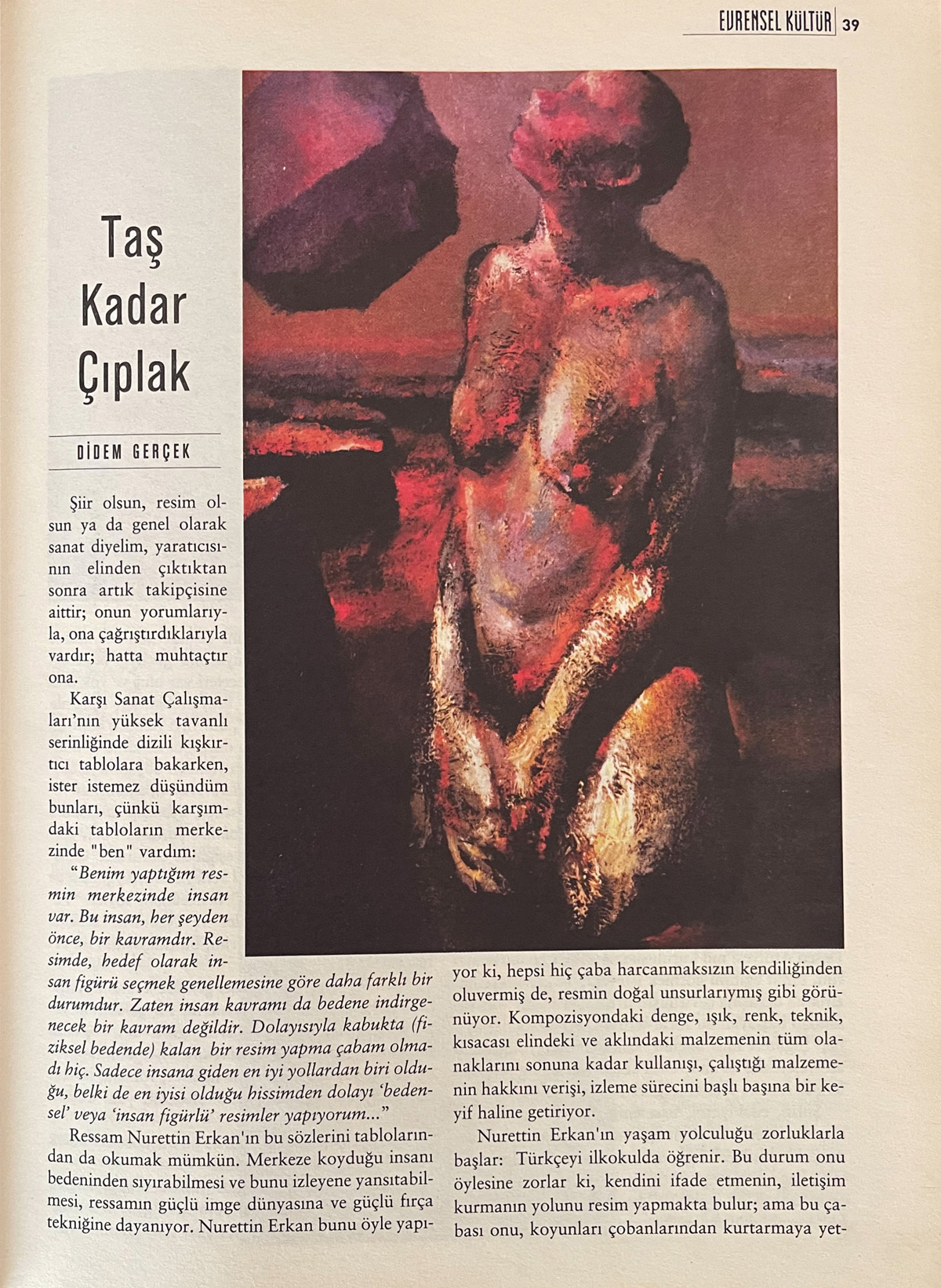
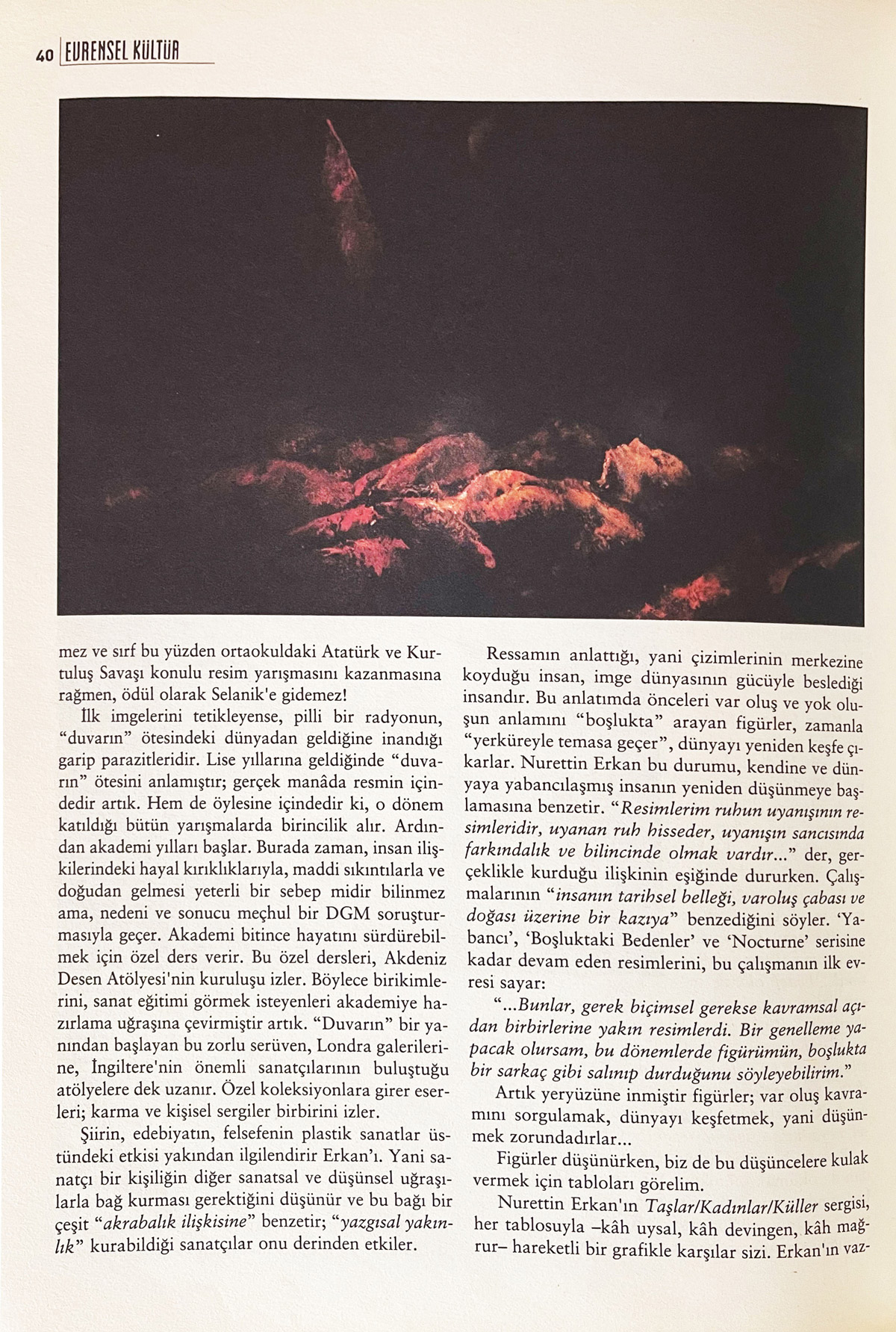
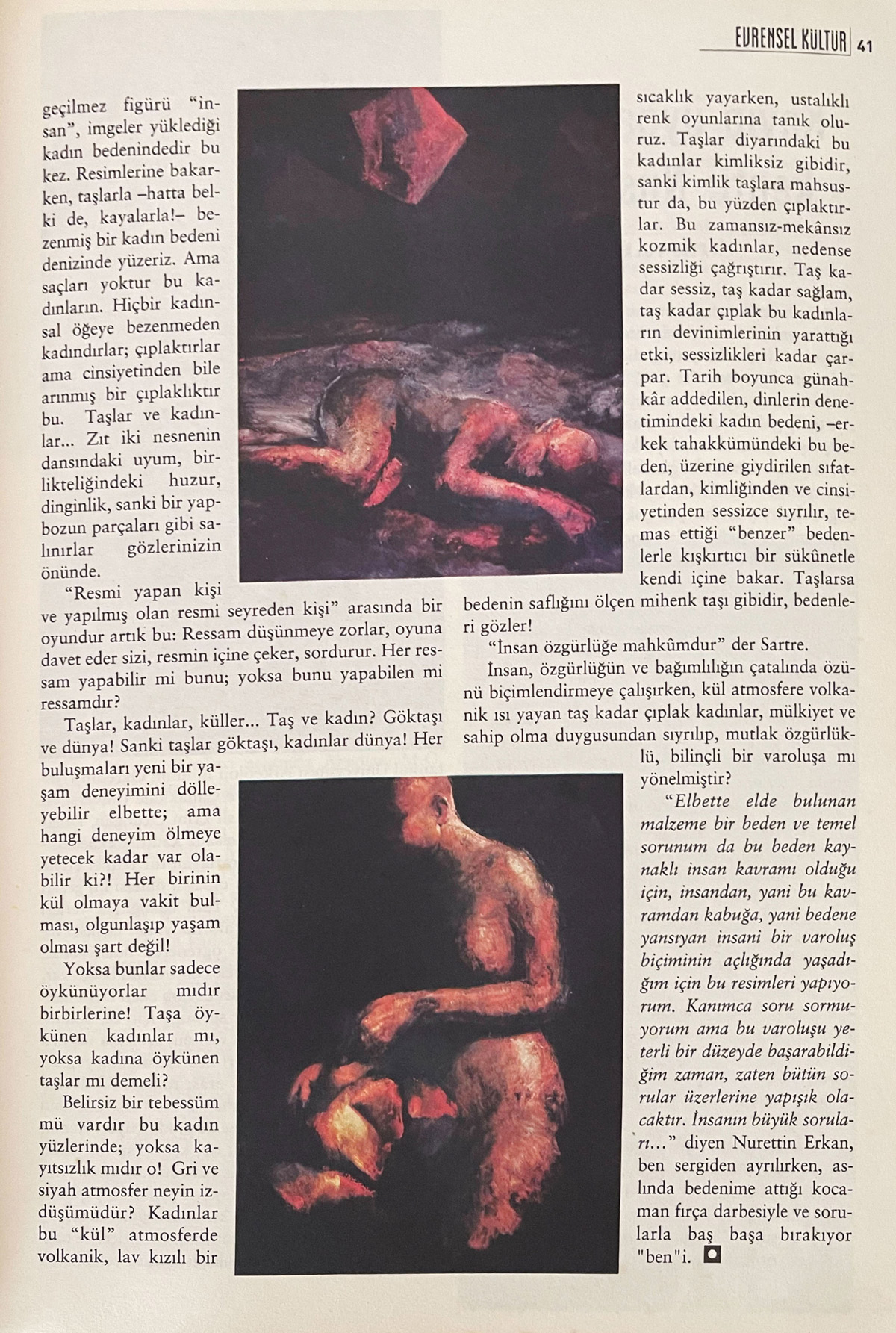
This time, Erkan’s ever-present figure of “the human” is embodied in the female form. As we look at these paintings, we seem to float in a sea of female bodies adorned with stones—or perhaps boulders. But these women are hairless. They bear no traditionally feminine features. They are nude—but it is a nudity cleansed even of gender.
Stones and women... In this dance of opposites, the harmony, the calm of their union, drift like puzzle pieces before our eyes.
Between the painter and the viewer, a game begins. The painter invites us to think, pulls us into the canvas, compels us to ask questions. Can every painter do this? Or is the true painter the one who can?
Stones, women, ashes… Stone and woman? Meteorite and Earth! Perhaps the stones are meteorites, and the women the Earth. Their meeting may seed new experiences—but which experience can survive long enough to overcome death? Not every encounter must end in ashes. Not all must ripen into life.
Or are they only imitating each other? Should we say women imitating stones—or stones imitating women?
Is there a faint smile on the faces of these women—or is it detachment? What casts this gray and black atmosphere? While the women radiate volcanic, lava-red warmth within this ash-colored world, we witness masterful play of color.
These women of the stone realm appear to be without identity—as if identity belongs to the stones. That’s why they are bare. These cosmic women—outside time and place—somehow evoke silence. As silent as stone, as solid as stone, as bare as stone. The power of their movement strikes just as deeply as their stillness.
Throughout history, the female body—deemed sinful, controlled by religions and male dominance—silently sheds the labels, identities, and gender imposed upon it. In contact with other similar bodies, it reflects inward, in provocative silence.
The stones become touchstones measuring the purity of the body. They watch the bodies.
“Man is condemned to be free.” —Jean-Paul Sartre
As the human tries to shape their essence in the clash between freedom and dependence, these women—bare as stones, radiating volcanic heat into the ash atmosphere—may be shedding the notion of possession and turning toward a fully conscious, truly free existence.
“Since the only material I have is the body, and my central concern is the concept of the human that emerges from this body, I create these paintings from a hunger for a human mode of existence that reflects from concept to shell, from idea to body. I don’t think I’m posing questions, but when I succeed in conveying this existence, all the great questions will cling to it. The great questions of humanity…”
And as I leave the exhibition, Nurettin Erkan leaves “me” face-to-face with myself—with a great brushstroke across my being and a mind full of questions.